AI Auto Parts Inventory Management: 2026 Guide
AI Auto Parts Inventory Management: 2026 Guide

AI-powered inventory management is the practice of using machine learning models, demand forecasting algorithms, and automated replenishment workflows to control stock levels across auto parts operations. Retailers and warehouse managers who want to streamline auto parts inventory management with AI face a specific set of challenges: catalogs with tens of thousands of SKUs, demand patterns that spike unpredictably, and parts that often lack standardized barcodes. Tools like SupplyChainStack, NetSuite Auto Parts ERP, and Intuendi are built specifically for these conditions. This guide covers the technologies, workflows, and implementation steps that produce measurable results.
What are the key AI tools for auto parts inventory management?
The right AI tools for automotive inventory control address three distinct problems: forecasting demand at the SKU level, automating replenishment, and maintaining accurate physical counts.
Demand forecasting platforms are the foundation. SupplyChainStack uses AI demand forecasting combined with lead-time-aware supplier workflows, managing domestic lead times of 3–7 days and overseas windows of 45–90 days within the same system. That matters because a single purchase order error on an overseas part ties up capital for three months. NetSuite Auto Parts ERP applies AI demand sensing to generate replenishment alerts that balance fill rates and carrying costs, with bin-level tracking and lot or serial traceability built in.

ABC/XYZ classification is the segmentation layer that makes forecasting practical. The top 20% of fast-moving SKUs are predictable enough for rule-based reordering. The long-tail 80% requires AI because manual forecasting at that scale is not feasible. XYZ classification adds demand variability as a second axis, so the system treats a high-volume but erratic SKU differently from a low-volume but steady one.
OCR and label recognition solve a problem most managers underestimate. Many automotive parts lack standardized barcodes, and OCR-based label reading improves counting accuracy where traditional barcodes are missing. Without accurate part identification at the point of receipt or count, every downstream AI model works from corrupted data.
Pro Tip: Before evaluating any AI forecasting platform, audit what percentage of your SKUs have reliable barcode or label data. If that number is below 90%, fix identification first. No forecasting model recovers from systematic mis-scans.
How does AI handle complex demand patterns in automotive inventory?
Spare parts demand is not like retail demand. It is intermittent and lumpy, meaning many SKUs sell zero units for weeks and then spike sharply when a repair trend hits a region.
A 2026 study in Scientific Reports found that stacking ensemble learning outperforms both traditional statistical methods and single machine learning or deep learning models for this type of demand. Stacking ensemble models combine multiple forecasting methods, including classical time-series models, gradient boosting, and neural networks, into a single output. The result is a forecast that captures both the slow baseline and the sudden spike better than any single method alone.
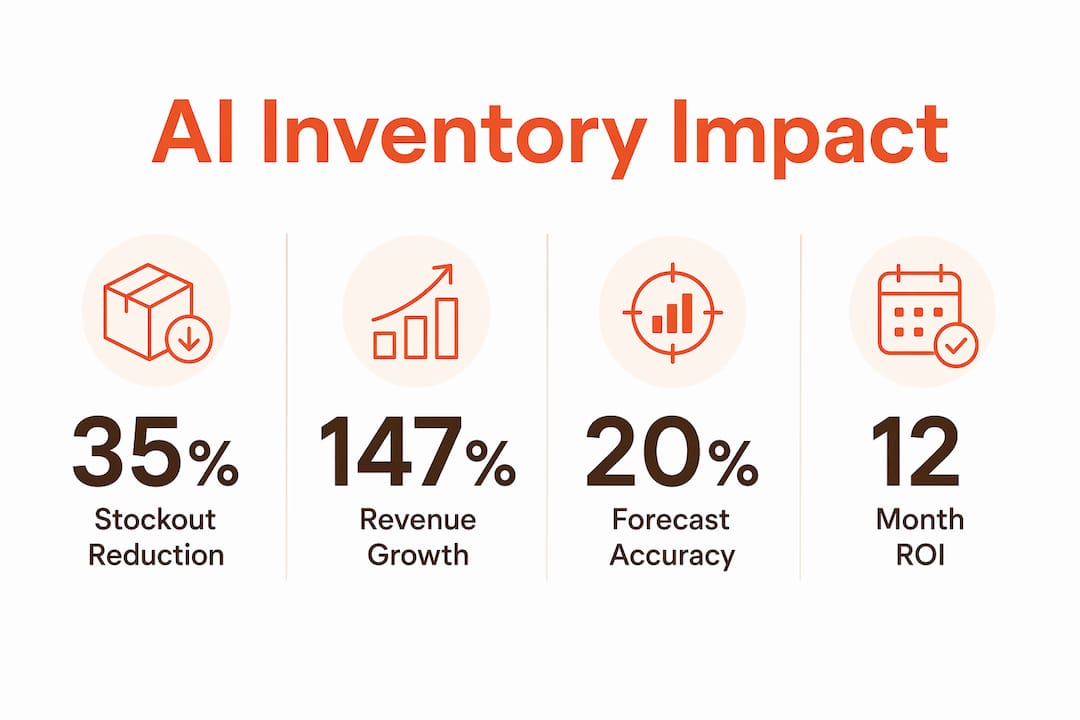
The real gain comes when forecasting connects directly to execution. Intuendi’s case study data shows that SKU and location-level planning reduces stockouts by 35% and increases revenue by 147% over two years, with a 32% improvement in ROI. Those numbers reflect a closed-loop system where the forecast drives purchasing and transfer decisions, not just a report that a manager reviews.
| Forecasting approach | Best use case | Key limitation |
|---|---|---|
| Classical time-series (ARIMA) | Stable, high-volume SKUs | Fails on intermittent demand |
| Single ML model (XGBoost) | Medium-complexity SKUs | Misses extreme spikes |
| Stacking ensemble | Intermittent and lumpy demand | Requires clean historical data |
| Rule-based reorder points | Very fast-moving, predictable SKUs | No demand variability handling |
The table above shows why no single method covers the full auto parts catalog. A well-configured AI system applies the right model to the right SKU segment automatically.
Pro Tip: Ask any AI vendor how their system handles SKUs with 12 or more consecutive zero-demand periods. If the answer is a single model applied uniformly, the system will over-order slow-moving parts and under-order the ones that matter.
What operational workflows does AI enhance in auto parts warehouses?
Inventory drift is the slow divergence between what the system says you have and what is physically on the shelf. It happens through receiving errors, mis-picks, returns processed incorrectly, and parts moved without a system transaction. Inventory drift causes oscillation in AI replenishment alerts, meaning the system alternates between over-ordering and under-ordering as it reacts to phantom stock levels.
Controlled cycle counting is the fix. Oracle Warehouse Management supports two counting modes that address high-SKU environments without shutting down warehouse throughput:
-
Summary-based cycle count. The Oracle WMS summary-based cycle count lets staff scan location-level summaries and capture discrepancies alongside pallet and LPN counts. This works well in dense storage areas where counting every SKU individually would halt operations.
-
Delayed approval cycle count. When a counter finds a discrepancy, Oracle’s delayed approval mechanism creates a recount task before any inventory adjustment is posted. A supervisor reviews and approves the adjustment. This prevents a single counting error from corrupting the inventory record that feeds the AI model.
-
OCR-assisted identification. For parts without barcodes, OCR reads OEM labels during the count. This closes the gap between physical reality and system records at the point of data capture, not after the fact.
The approval workflow detail matters more than most managers expect. Without it, a miscounted location triggers an AI replenishment alert, an unnecessary purchase order goes out, and the overstock sits for months. With it, the system flags the discrepancy, a recount confirms the true quantity, and the AI model receives accurate data.
-
Assign cycle count frequency by ABC/XYZ segment. A-class parts should be counted monthly; C-class parts quarterly.
-
Integrate cycle count results directly into the AI model’s training data refresh cycle.
-
Track discrepancy rates by location and by counter to identify systemic errors early.
How to implement AI-driven inventory management in your auto parts business
Implementation fails most often at the data preparation stage, not the technology stage. Follow these steps to avoid the common pitfalls.
-
Audit data integrity first. Pull a sample of 500 SKUs and check barcode accuracy, unit-of-measure consistency, and historical demand completeness. If error rates are high, fix the upstream data before touching any AI platform.
-
Select and integrate your platform. SupplyChainStack and NetSuite both offer ERP and WMS integration paths. Match the platform to your existing system architecture. A platform that requires a full ERP replacement adds 12–18 months to your timeline before any AI benefit is realized.
-
Configure ABC/XYZ segmentation. Set classification thresholds based on your actual sales velocity and demand variability data, not industry defaults. Auto parts catalogs vary widely between a retailer focused on collision parts and one focused on maintenance consumables.
-
Deploy stacking ensemble forecasting for the long tail. Apply rule-based reorder points to A-class, high-velocity SKUs. Reserve the ensemble model for the B and C segments where demand is irregular.
-
Set up cycle counting with approval workflows. Configure Oracle WMS or your equivalent system to require supervisor sign-off on adjustments above a defined variance threshold. Start with a 5% variance trigger and adjust based on your error rate data.
-
Monitor KPIs weekly for the first 90 days. Track stockout rate, overstock value, replenishment alert accuracy, and cycle count discrepancy rate. These four metrics tell you whether the AI model is working from good data.
| Implementation stage | Common pitfall | Correct approach |
|---|---|---|
| Data audit | Skipping it to save time | Fix barcode and UOM errors before AI deployment |
| Platform selection | Choosing based on features alone | Match to existing ERP/WMS integration capability |
| Segmentation | Using default thresholds | Set thresholds from your own sales velocity data |
| Forecasting model | Applying one model to all SKUs | Use ensemble models for irregular demand segments |
| Cycle counting | No approval workflow | Require supervisor sign-off on variance adjustments |
Arosplatforms reports that clients who complete a structured data audit before deployment see returns within twelve months and an average of 82% faster turnaround on key operational tasks. Skipping the audit extends that timeline significantly.
Key takeaways
AI-driven automotive inventory control produces measurable results only when accurate physical data, the right forecasting model, and controlled replenishment workflows operate together.
| Point | Details |
|---|---|
| Data quality comes first | Fix barcode and label accuracy before deploying any AI forecasting model. |
| Use ensemble forecasting for irregular SKUs | Stacking ensemble models outperform single methods for intermittent and lumpy demand. |
| Connect forecasts to execution | Linking AI outputs to purchasing and transfers drives stockout reduction and revenue gains. |
| Control cycle counting with approvals | Delayed approval workflows prevent counting errors from corrupting AI replenishment alerts. |
| Monitor four KPIs weekly | Track stockout rate, overstock value, alert accuracy, and discrepancy rate for the first 90 days. |
What I’ve learned from AI inventory implementations in auto parts
The most common mistake I see is treating AI as a forecasting upgrade when it is actually a data discipline. Every client who struggled with oscillating replenishment alerts had the same root cause: inventory drift that had never been addressed systematically. The AI model was not broken. It was working perfectly on bad data.
The second thing I have observed is that linking forecast outputs to procurement is where the financial results actually appear. A forecast sitting in a dashboard that a buyer reviews once a week produces modest gains. A forecast that automatically triggers a purchase order or a warehouse transfer produces the 35% stockout reduction and the revenue growth that case studies report.
The uncomfortable truth about AI in auto parts is that the technology is not the hard part. The hard part is the operational discipline: consistent cycle counting, barcode accuracy, and approval workflows that prevent bad data from entering the system. Retailers who build that discipline first and add AI second outperform those who do the reverse. The AI use cases that deliver real ROI are always built on a foundation of clean, controlled inventory data.
— Rohan
How Arosplatforms supports AI inventory transformation
Auto parts retailers and warehouse managers who want to move from manual inventory control to AI-driven operations need more than software. They need a deployment approach that fits their existing ERP, WMS, and supplier workflows.

Arosplatforms builds customized AI operating systems for automotive and logistics operations, embedding directly within client workflows to address the specific challenges covered in this guide. From AI consulting by market and region to full platform integration, the team focuses on rapid ROI without vendor lock-in. Managers who want to see how similar operations have performed can review real customer outcomes across automotive and adjacent sectors. The next step is a direct conversation about your current inventory challenges.
FAQ
What is AI-powered inventory management in auto parts?
AI-powered inventory management uses machine learning models and automated workflows to forecast demand, trigger replenishment, and maintain stock accuracy across large auto parts catalogs. It replaces manual reorder point calculations with SKU-level and location-level predictions that adapt to changing demand patterns.
Why does stacking ensemble forecasting work better for spare parts?
Spare parts demand is intermittent and lumpy, meaning standard statistical models miss the spikes. Stacking ensemble models combine multiple methods to minimize forecasting errors across both stable and irregular demand patterns.
How does inventory drift affect AI replenishment alerts?
Inventory drift causes the AI system to generate replenishment alerts based on incorrect stock levels, leading to unnecessary orders or missed restocks. Controlled cycle counting with delayed approval workflows corrects drift before it reaches the AI model.
What results can AI inventory management deliver in auto parts?
Intuendi’s case study data shows 35% stockout reduction and 147% revenue growth over two years when AI forecasting connects directly to purchasing and transfer execution.
How do I handle auto parts that lack barcodes?
OCR-based label reading identifies parts using OEM label text when standard barcodes are absent. Resolving identification accuracy before AI deployment is the single most important data quality step for automotive inventory operations.